
Laig Bay whirlpool

Laig Bay pool and stones
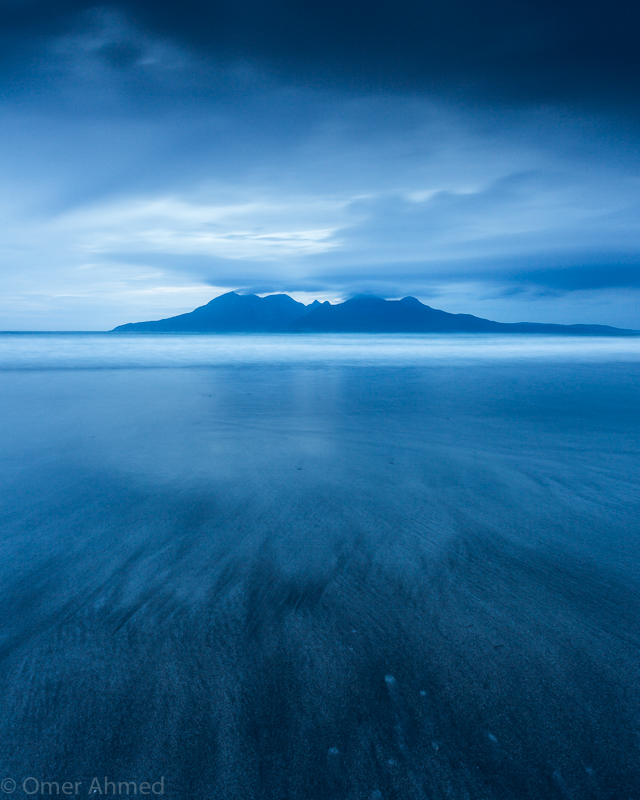
Laig Bay blue
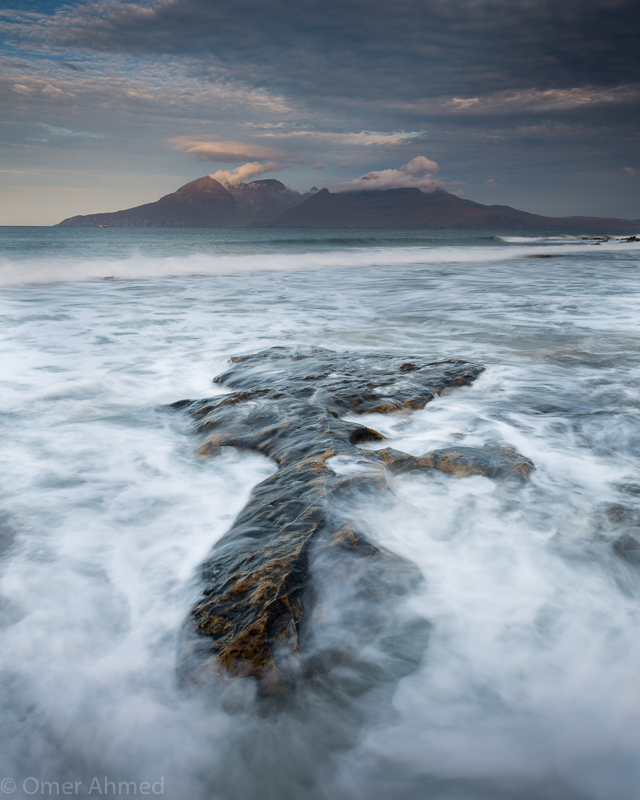
Laig Bay map rock

Laig Bay gold

Laig Bay dawn rock
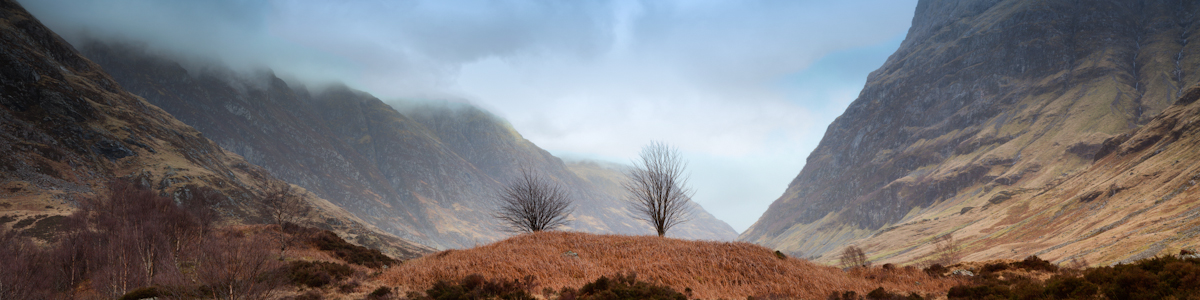
Laig Bay whirlpool
Laig Bay pool and stones
Laig Bay blue
Laig Bay map rock
Laig Bay gold
Laig Bay dawn rock

mirror man, Loch Earn, St Fillans.
After a relaxing day out at Glen Orchy and Glen Etive with a couple of landscape photography buddies we headed home as the light faded. Joe was keen to check out this chap who has been installed at one end of Loch Earn. Looks a bit like an alien who has come to visit us from across the galaxy somewhere.

Taransay from Beinn Dhubh
Taransay from Beinn Dhubh, Isle of Harris. Hazy but beautiful light. Moderate wind and swell. Canon 5D3, f/8, 1/30th”, 17-40lens at 24mm, ISO100. 1 stop hard grad ND filter on the sky.
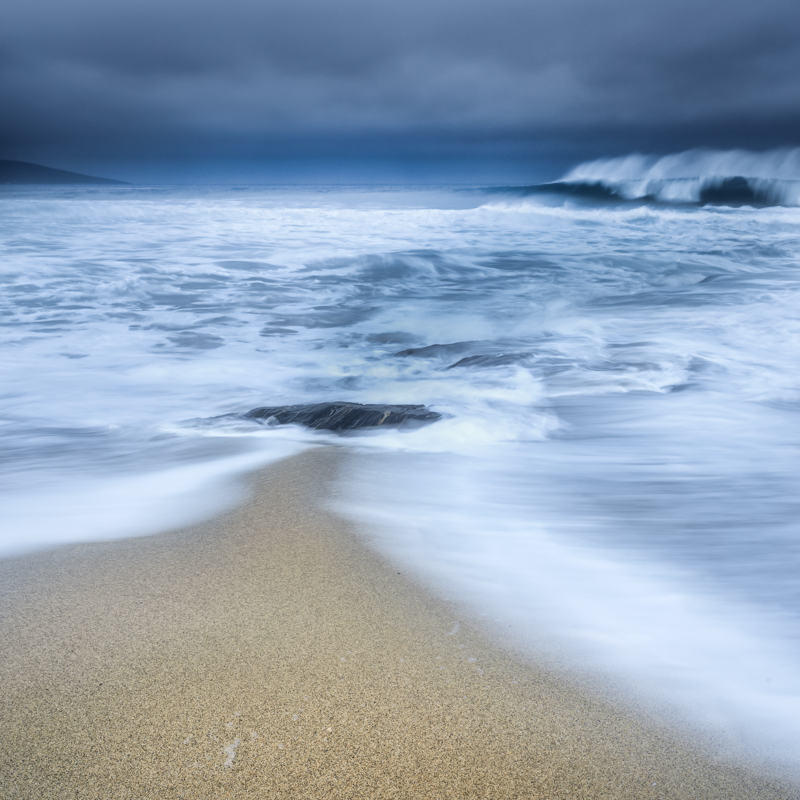
Scarista Beach, Isle of Harris
Canon 5D3, 0.5″@f/11 ISO100. 17-40L lens at 29mm.
Stormy conditions but the soft light had the usual Harris effect of turning everything into pastel shades. The stormy conditions first thing in the morning meant we had this corner of paradise all to ourselves.
Two shots from the Troon a beach town on the west coast of Scotland. West coast sunsets can be a grey dull thud or an all singing, all dancing affair of light and colour.
I need to get a bit more decisive. Normal exposure or long exposure? I keep dithering between the two.
Tech: 5D3, 24-70 lens, 2 stop hard grad on the sky and a 6 stop ND for the long exposure.
Conditions: Very still, moderate visibility. Broken cloud.

Troon sunset with concrete.

Troon sunset with concrete. Long exposure.
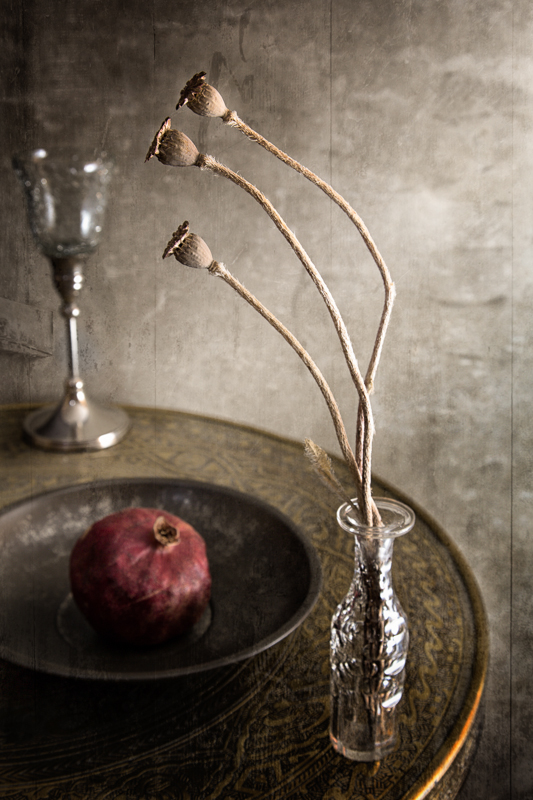
Poppies and Pomegranate
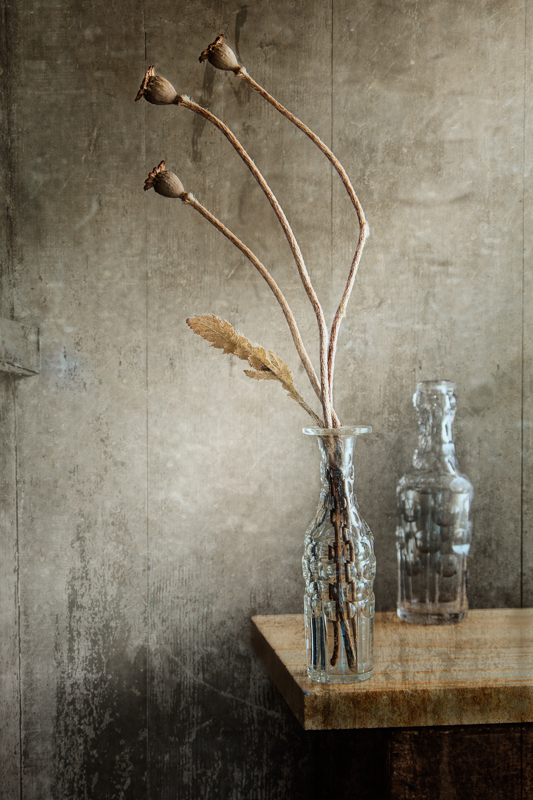
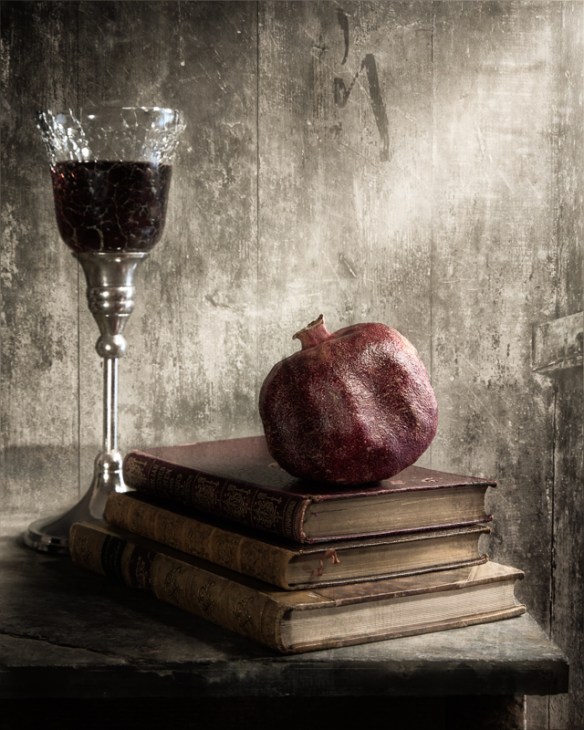
Three recent still life images.
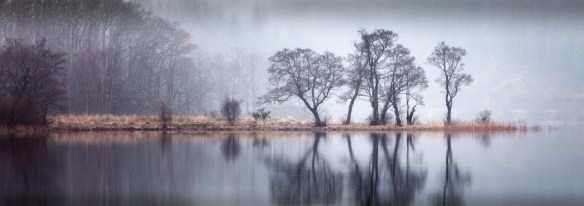
Loch Chon, Trossachs, Scotland.
On most days this stand of trees is hard to make out against the conifers on the hill behind. One of the great benefits of the Scottish weather is the frequency of mist and rain that throws a soft blanket over the distant forest making the whole scene “pop”. Nature’s own Photoshop.
Tech: camera 5DMk2, Lens: 20-200L at 150mm, ISO100, 1/10 sec at f/8.
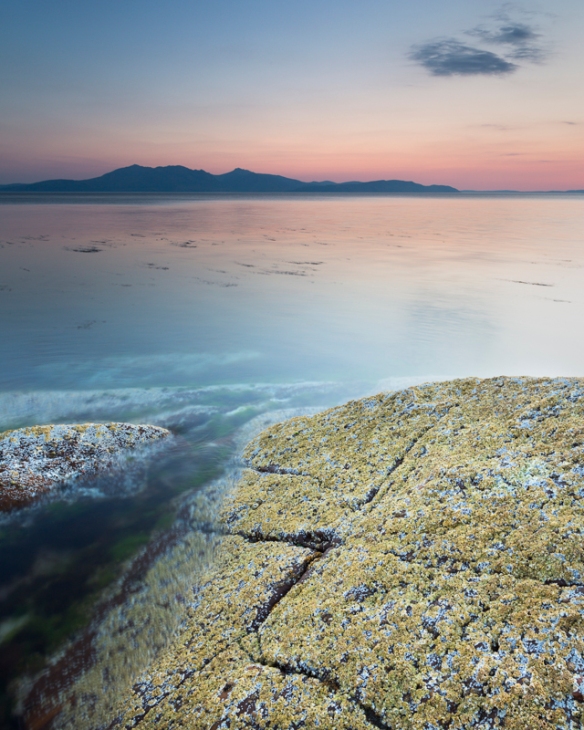
Portencross Sunset with Small Cloud
Technical: canon 5D3, 17-40 lens at 20mm, ISO100, 2″@f/16. Lee filters on the sky.
Conditions: slight breeze at sunset with a gentle swell on the water.
I can’t make up my mind about the balance of this image. There is a diagonal that goes up to the small cloud and seems to balance with the small rock lower left. It’s bottom heavy. Perhaps a square aspect ratio but then those nice lines in the rock are lost.

Still Life With Pear and Tools
Technical:
Canon 5D3, 24-70 lens at 48mm, 4″@f/8.
Lighting: upper left from a diffused continuous lamp covered to give a sliver of light. Small desk lamp back right to give a slight rim on the pear. Shot against black with lots of bits of card to control light.
8 shots focussed at different points then aligned and focus stacked in PS6 after RAW processing in LR4. Background texture is a wall shot blended using Lighter Colour mode and brushed off the subject by hand. Final image worked through a bleach bypass and then darkened below the table and to the right using curves adjustment with gradient masks. Finally a shaft of light was created on the background layer by using a further curves adjustment with a reflected gradient mask.
The technical aspects are less of a challenge now as there isn’t that much too it. As always there is more to learn. I should have taken a shot focused on the back of the table as it’s not logical for the back of the table to be out of focus but the background wall to be in focus!
For me the biggest challenge remains subject. What to make images off or more importantly why make this image. Landscape work can fall back on the “because it’s there” argument to justify itself. Still life is harder. “It” is only there because you put it there so it is impossible to dodge the question “why?”. What is it that you want to say through the image?
So here I have to confess that I was making it up as I went along. I had some interesting old tools and a slab of rock so I arranged them using some judgement and some application of compositional rules. The kids were demolishing pears and I needed something curvy to finish the shape I was looking for so I saved one and added it to the arrangement. That’s it. No plan.
Where does that leave things? It would be nice to say that there was some artist’s vision that dictated the materials and the composition. Perhaps that would give the image some gravitas. On the other hand, perhaps there were subconscious processes at work here putting the unchanging and eternal material beside the organic and impermanent pear (which has since been devoured) as a comment on the frailty of life. A retrospective justification indeed!
Poor David Byrne. He was the overall winner of the Take a View Landscape Photographer of the Year Award but has been disqualified. From his comments and those of the judges he seems like a very genuine bloke who simply didn’t read the rules closely enough so did not realise that adding in elements from more than one image was not allowed. I suppose that is fair enough and he has been very sincere in putting his hands up and there was clearly no intention to cheat.
So, for me, it raises a question. What is a landscape photograph? There are now many kinds of landscape image making which involve a camera. At one end there are single RAW files to be presented “in the raw” (that’s a bad idea by the way!) or tonally adjusted to taste and presented. There are multiple exposures of the same scene that multiply the capabilities of our digital sensors but leave the temporal singularity of the scene (effectively) intact. Then there is the creative use of camera movement, filters and lens effects to give a personal interpretation. Finally there is the compositing of multiple exposures which are dislocated in time and space to give an image which conveys something of interest to the image-maker.
My view is simple. These are all different but all valid. For a landscape competition the crucial thing is that the rules should be clear and be followed. For our every day image making should we not do whatever makes us happy? David Byrne’s images are fabulous. I love them and would happily have them on the wall of my study. The only fault is that they don’t follow the rules of this competition.
As food for thought I’m posting an image I made 2 days ago at Portencross, Scotland.
The three images from left to right show: RAW file processed in Lightroom, centre is the same image layered with a monochrome version in Photoshop to allow some tonal adjustment, the last version takes a fisherman (who was there 2 minutes before and then left) and composites him into the shot. For me the first 2 are landscape shots and the last is a story composite. The line is some where between the 2nd and 3rd image. I think…I could be wrong…
For comparison the original RAW image (unprocessed follows).
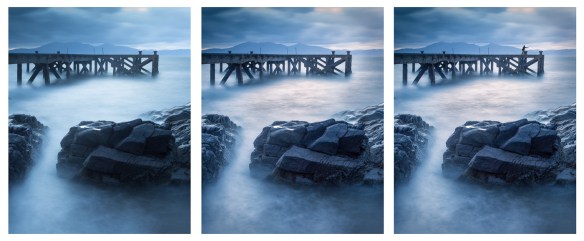
Portencross Example 3rd Nov 2012

Portencross Example 3rd Nov 2012 RAW unprocessed
 wytchwood